
Earning a Decent Income but Still No Clear Savings or Investment Direction?
Earning a Decent Income but Still No Clear Savings or Investment Direction?
Jan 12, 2026
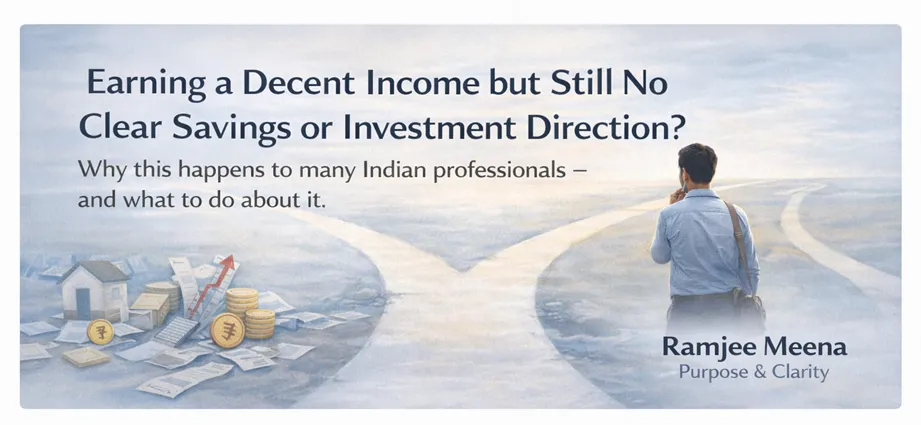
Earning a Decent Income but Still No Clear Savings or Investment Direction?
(Why this happens to many Indian professionals — and what to do about it)
If you are earning a decent income but still feel unsure about your savings or investments, you are not alone.
This confusion is far more common than people admit — especially among mid-career Indians.
On the surface, everything looks fine.
- Salary is regular.
- Responsibilities are managed.
- Life is moving.
But inside, there is a quiet discomfort.
You earn well, yet you are not confident about:
- Whether you are saving enough
- Whether your investments make sense
- Whether your money is actually building security or just circulating
This is not a money problem.
It is a clarity problem.
The Hidden Reality Behind “Decent Income”
Most Indian professionals were taught one thing very well:
How to earn.
Very few were taught:
- How to decide
- How to pause
- How to give money a direction
So what happens?
Money decisions are taken on autopilot.
- Saving happens if something is left
- Investments happen because someone suggested
- Big decisions are postponed because fear and confusion exist
Over time, this creates anxiety.
Not because income is low —
but because direction is missing.
This is what I call earning without orientation.
Why More Income Does Not Automatically Bring Peace
There is a popular belief that once income crosses a certain level, clarity will follow.
In reality, the opposite often happens.
As income increases:
- Responsibilities increase
- Expectations increase
- Risks increase
Without clarity, higher income simply means higher pressure.
You start worrying about:
- EMIs
- Children’s education
- Health emergencies
- Retirement
- “What if something goes wrong?”
And yet, you don’t feel confident enough to take strong decisions.
That is when stress silently enters.
Stage 1: Purpose & Clarity — Where Everything Actually Begins
In my 5-stage life framework, this situation belongs to Stage 1: Purpose & Clarity.
This stage is not about:
- Returns
- Asset classes
- Market timing
It is about honest observation.
Before planning money, you must answer one fundamental question:
Why am I earning in the first place?
Without this answer:
- Savings feel insufficient
- Investments feel risky
- Growth feels forced
Clarity must come before action.
The Current Reality Check Most People Avoid
A Current Reality Check is uncomfortable — which is why most people skip it.
It asks simple but confronting questions:
- If my income stopped for six months, what would protect my family?
- Do I actually know where my money is going every month?
- Are my financial decisions intentional or reactive?
Many people avoid these questions because they fear the answers.
But avoidance does not remove risk.
It only hides it.
Awareness replaces illusion.
That is the first breakthrough.
The Difference Between Earning and Owning Your Life
Another reason clarity is missing is identity attachment.
Many professionals unconsciously think:
“My job will take care of me.”
So they delay decisions.
They postpone planning.
They depend emotionally on salary stability.
This is not wrong — but it is incomplete.
You are not just an employee.
You are a life owner.
Your income should serve your life —
not decide your peace.
When this shift happens, thinking changes.
You stop asking:
- “How much can I earn?”
And start asking:
- “What kind of life am I trying to protect and build?”
That question brings calm power.
Why Random Investing Creates More Fear Than Growth
Many people try to solve confusion by “doing something.”
They invest because:
- A colleague suggested
- A relative recommended
- A trend looked attractive
This creates activity — not clarity.
Random investing without purpose:
- Increases anxiety
- Reduces confidence
- Creates regret later
Action without direction does not create growth.
It creates noise.
That is why slowing down is sometimes the smartest move.
A Simple Way to Regain Direction (Without Overthinking)
You do not need to fix everything at once.
Start small.
Ask yourself three questions:
Q-1 : What is my money meant to protect first?
(Family security, health, peace, stability)
Q-2 : What decisions am I avoiding due to fear or confusion?
Q-3 : If I make no changes for five years, will my life improve or become tighter?
Write the answers.
Don’t judge them.
Clarity grows through observation, not pressure.
Growth, Freedom, and Contribution — In the Right Order
Many people want freedom.
Some want contribution.
But they skip growth clarity.
That creates imbalance.
The natural order is:
- Growth — understanding yourself and your reality
- Freedom — reducing dependence and pressure
- Contribution — giving back meaningfully
When income is aligned with purpose:
- Growth feels calm
- Freedom feels earned
- Contribution feels natural
This is long-term thinking.
This is sustainable living.
What You Can Expect Once Clarity Sets In
When clarity improves:
- Decisions become slower but stronger
- Fear reduces
- Confidence becomes internal
You stop chasing every opportunity.
You start choosing intentionally.
Money becomes a tool, not a source of anxiety.
That is the real upgrade.
A Final Reflection
Earning a decent income is a privilege.
But clarity is a responsibility.
Before asking:
“Where should I invest?”
Ask:
“Why am I earning, and what do I want this money to do for my life?”
Clarity first. I Growth later. I Peace always.
Reflect honestly:
If nothing changed in your financial direction for the next five years, would your life feel safer — or more stressful?