The Silent Cost of Low Self-Esteem: Why Success Alone Never Feels Enough
The Silent Cost of Low Self-Esteem: Why Success Alone Never Feels Enough
Apr 20, 2021
Studies suggest that 85% or more of people worldwide struggle with some degree of low self-esteem.
This is not a condition limited to the poor, the uneducated, or those from disadvantaged backgrounds. In fact, it quietly affects people from every walk of life—including those who appear confident, accomplished, and outwardly successful.
Low self-esteem does not always show up as weakness. Often, it hides behind achievement.
Many highly successful professionals and business leaders struggle with self-esteem in subtle but painful ways.
They may feel socially inadequate, uncomfortable in close or intimate relationships, or dissatisfied with their physical appearance or health.Some feel emotionally empty, realizing—often too late—that they have not experienced joy, play, or balance for years. Work becomes their safe zone, the one place where they feel competent, respected, and in control.
For many, success becomes compensation.
Driven individuals often channel unresolved feelings of inadequacy into relentless effort. Business and career become the battlefield where they attempt to prove their worth. And to their credit, they often succeed. They achieve positions, titles, income, and recognition that others admire.
But while they shine professionally, other areas of life—relationships, recreation, health, emotional and spiritual growth—are quietly neglected.
There is nothing wrong with excelling in one’s profession. The problem arises when achievement is fueled by the belief that one is not “enough” as they are.
When success is rooted in self-doubt, it can never satisfy.
Many high achievers are unknowingly trying to heal an internal wound through external accomplishments.
They believe that if they reach the next milestone, earn more, gain more respect, or prove themselves one more time, they will finally feel whole. This creates the illusion of fulfillment—brief, fleeting, and fragile.
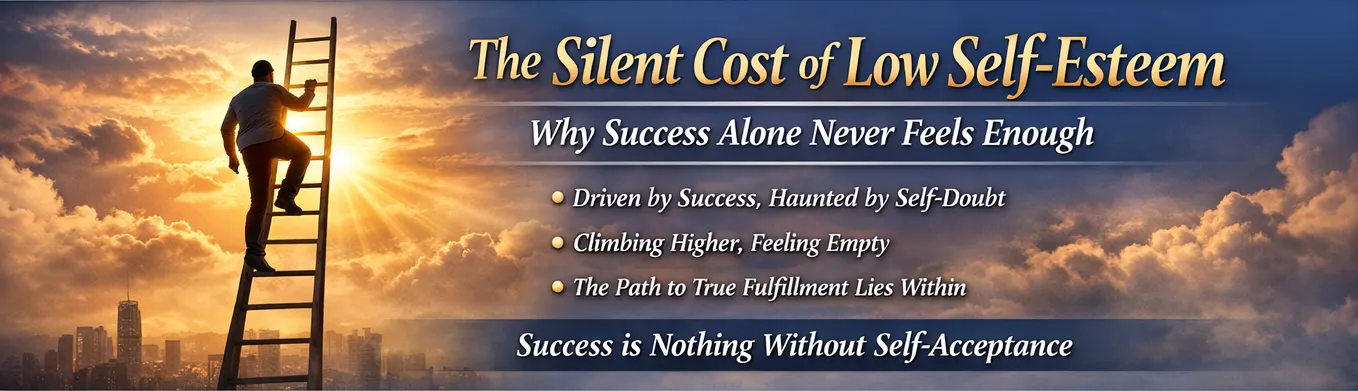
It is like climbing a ladder whose top disappears into the clouds.
They believe that somewhere at the top lies peace, happiness, and self-acceptance. But no matter how high they climb, there is always another rung. Another goal. Another benchmark.The finish line keeps moving. Even when they “arrive,” the satisfaction fades quickly, replaced by a new pressure to do more, be more, and prove more.
The deeper issue is not performance—it is the foundation.
When the ladder of success is built on the belief that “I am not good enough,” it stands on quicksand. The climb becomes exhausting, and the fall—burnout, emptiness, broken relationships, declining health—is often sudden and painful.
Perfection is chased but never reached. Flaws are magnified. Fear of being exposed as inadequate never fully disappears.
This is why true fulfillment remains elusive.
The core message of The Self-Esteem Book is simple yet profound: no one needs to live a diminished life because of a damaged sense of self-worth.
Most people, consciously or unconsciously, accept the idea that something is wrong with them—that they are flawed, unworthy, or undeserving of love, peace, and abundance.
These beliefs are rarely born in adulthood. They are learned, absorbed, and reinforced through past experiences.
By courageously examining the past—without blame or self-pity—individuals can identify the roots of their resignation and self-doubt.
When past events are reinterpreted with awareness and compassion, emotional wounds can be healed. Negative self-talk loses its grip. Energy that was trapped in unresolved experiences becomes available again.
From this place, a powerful shift occurs.
Life is no longer driven by the need to prove worth, but by a conscious choice to strive for excellence, contribute meaningfully, and live in alignment with one’s values. When people truly believe they matter—that they can impact others and the world—they naturally experience greater happiness, fulfillment, and peace.
The cost of low self-esteem extends far beyond personal unhappiness.
In business and leadership, unresolved self-esteem issues silently erode effectiveness.
When energy is consumed by self-doubt, fear of failure, or unresolved past experiences, it is unavailable for creativity, presence, and impact. Personal power diminishes. Purpose becomes blurred. Gifts remain underutilized.
Relationships suffer as well.
People with low self-esteem often misinterpret neutral words or actions as criticism or rejection. They may withdraw, play small, or avoid situations where they risk being judged.
Others overcompensate—working excessively, controlling outcomes, or seeking constant validation. In both cases, genuine connection suffers, and charisma fades as attention turns inward rather than outward.
Ironically, the very behaviors meant to prove worth end up limiting influence and contribution.
Escaping this cycle requires a deliberate process.
The path out of diminished self-esteem and endless striving lies in a three-step transformation:
- Healing the past so it no longer drains emotional energy or unconsciously shapes decisions.
- Clarifying the present, identifying what is working, what is missing, and what truly matters—so life can be lived consciously rather than reactively.
- Designing the future intentionally, choosing goals and directions that excite, align, and honor one’s true nature.
When low self-esteem, resignation, and self-pity are released, something remarkable happens. Life becomes lighter.
Choices become clearer. Effort becomes more effective. People reconnect with their inherent worth and their God-given potential.
From that place, success is no longer a substitute for self-love—it becomes an expression of it.
And fulfillment, finally, is no longer chased.
It is lived.
Summary
Many successful business professionals suffer from diminished self-esteem, often without realizing it.
This hidden struggle undermines effectiveness, relationships, fulfillment, and long-term success.
By addressing the root causes of low self-worth—rather than compensating through overachievement—individuals can dramatically improve their personal and professional lives.
When self-acceptance replaces self-doubt, effort multiplies in impact, fulfillment deepens, and success becomes sustainable—both financially and emotionally.